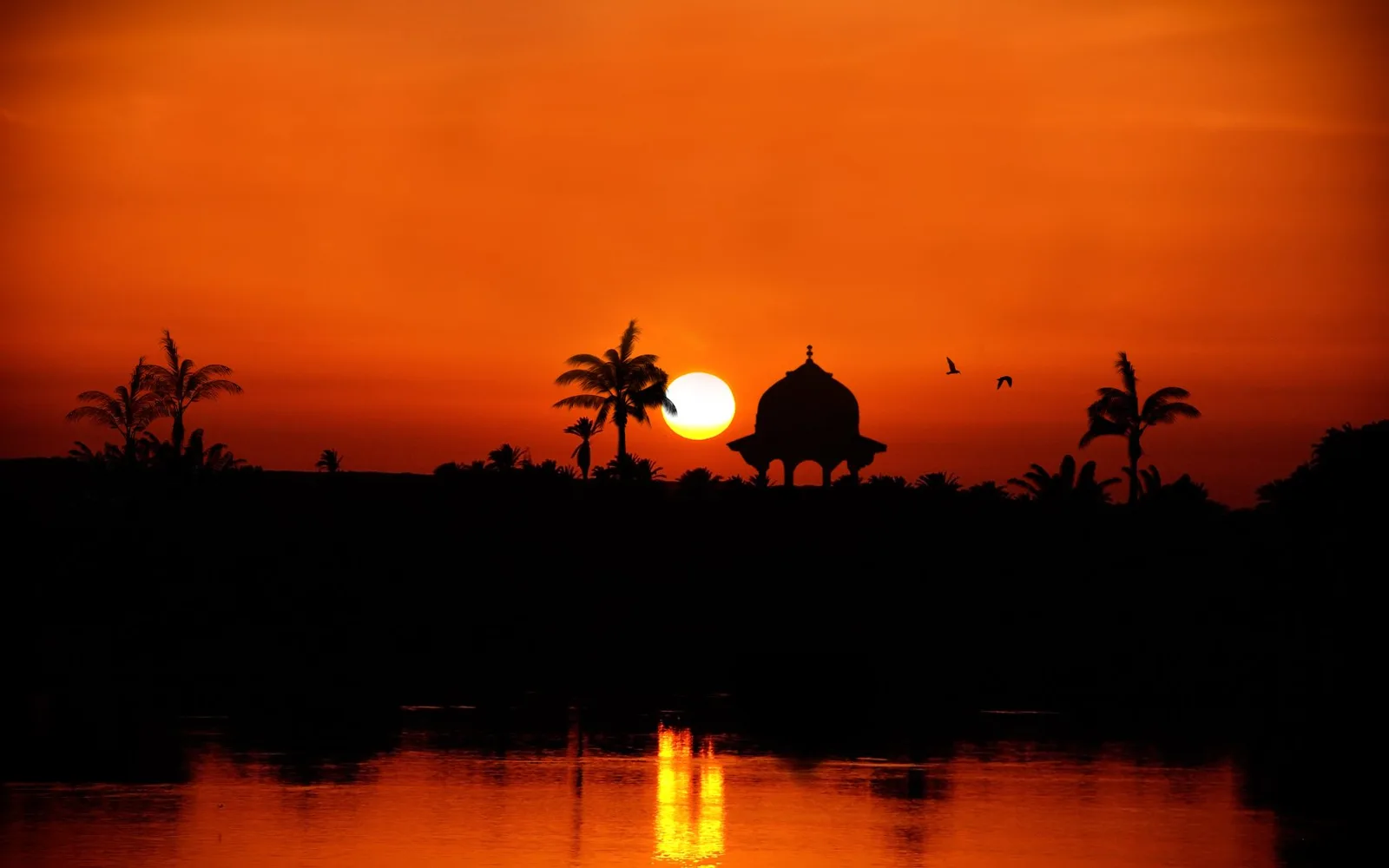
Some places are visited. Egypt is felt. It is a country where the sand remembers the footsteps of kings, where a river older than any empire still slides past cities of glass and stone, and where the oldest of the Seven Wonders of the Ancient World has watched the sun rise for around forty-five centuries.
People have come here for thousands of years looking for answers: pilgrims, conquerors, scribes, treasure hunters, dreamers. Today the questions are the same ones. How did they build all this? What did they believe? What are we still not being told? This is a tour of Egypt through all of those questions, from the scripture and the gods to the curse and the conspiracy theories, and finally to the practical wonder of standing there yourself.
The Gift of the Nile
The Greek historian Herodotus called Egypt "the gift of the Nile," and a flight over it shows why. A narrow ribbon of green runs through a desert the size of a continent. On either side of that ribbon, the land is gold and empty. Inside it are farms, palm groves, ancient temples and, today, tens of millions of people.
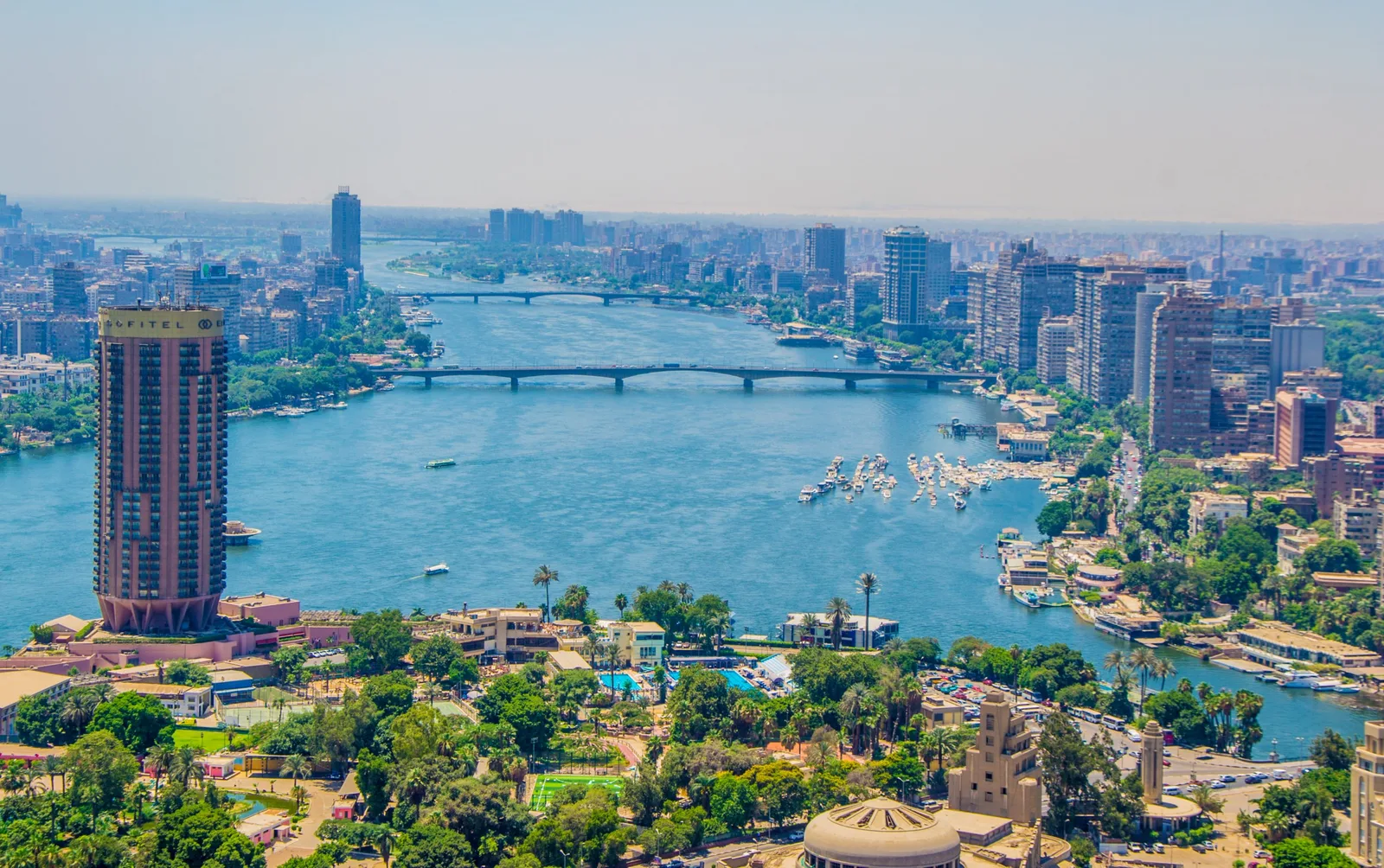
Every year, before the dams, the river flooded and left behind a layer of black silt. The ancient Egyptians called their homeland Kemet, the Black Land, after that fertile soil, and called the desert beyond it Deshret, the Red Land. Life and death sat side by side, a few steps apart. It is no accident that the Egyptians built their homes on the east bank, where the sun rises, and their great tombs on the west, where it sets.

Egypt and the Bible
Egypt is one of the most important places in the Bible after Israel itself. It appears from the earliest chapters to the New Testament, usually as a place of refuge, sometimes as a place of bondage, and always as the greatest power of the known world.
Abraham. In Genesis 12, famine drives Abram down into Egypt, where he meets a pharaoh. It sets a pattern: when the land failed, people went to Egypt, because the Nile kept feeding it.
Joseph. The story of Joseph in Genesis 37 to 50 may be the most Egyptian story in scripture. Sold by his brothers, he rises from prison to become the pharaoh's right hand after interpreting dreams of seven fat years followed by seven lean ones. He stores grain through the good years and saves the country, and then his own family, in the famine.
Moses and the Exodus. The book of Exodus opens with the Israelites enslaved and building the store cities of Pithom and Rameses (Exodus 1:11). Moses, raised in the pharaoh's house, confronts the king, the ten plagues fall, and the first Passover marks the night of the escape (Exodus 12).
The New Testament. In Matthew 2, Joseph, Mary and the infant Jesus flee to Egypt to escape Herod, and the gospel quotes the prophet Hosea: "Out of Egypt I called my son."
What does archaeology say? This is a genuine debate, and it is worth being honest about it. The Bible names very few pharaohs. The first one named outright is Shoshenq I, the Shishak of 1 Kings, and the pharaoh of Joseph and of the Exodus goes unnamed. Scholars who take the story seriously have proposed different rulers: many point to the long reign of Ramesses II (c. 1279 to 1213 BC), who built a great capital in the Nile Delta that fits the "city of Rameses," while others argue for different kings and dates altogether. A famous inscription, the Merneptah Stele, mentions a people called "Israel" in about 1208 BC, which places Israel on the map of Egypt's world quite early. Archaeology has not settled the questions of the Exodus, and people of deep faith and of no faith disagree. What nobody disputes is that the Egypt of the Bible is real, and you can walk through its temples.
The Pharaohs
The word "pharaoh" comes from the Egyptian per-aa, "great house," the royal palace, and over time the name moved from the building to the king. A pharaoh was not only a ruler. He or she was the link between gods and people, responsible for keeping ma'at, the order and balance of the universe, intact.
Egypt's story is a long sequence of kingdoms. In the Old Kingdom, the architect Imhotep designed the stepped pyramid for King Djoser, stacking one mastaba tomb on another until it climbed to the sky. His successors worked toward the smooth-sided pyramid, culminating at Giza under Khufu. In the New Kingdom, Egypt became an empire, and its kings, Thutmose, Akhenaten, Tutankhamun, Ramesses, are the ones most people picture when they hear the word pharaoh.
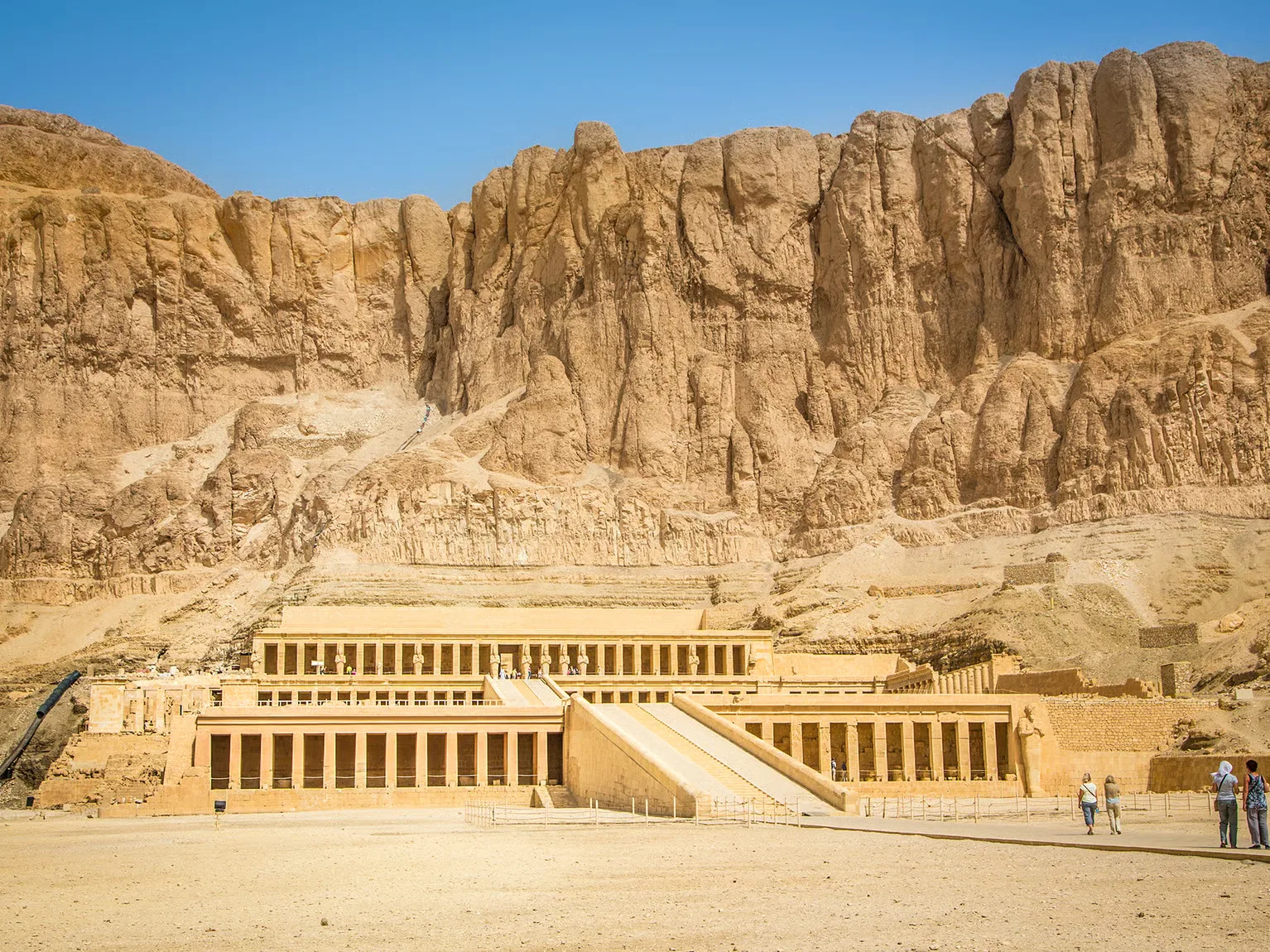
Few pharaohs inspire more wonder than Hatshepsut, who ruled as a woman in a world of kings. She took the throne around 1479 BC, wore the royal regalia, and built what is still one of the most beautiful buildings in Egypt, a terraced temple of colonnades rising from the desert floor to the cliffs behind it. Its walls record a trading expedition to Punt, which the Egyptians called "God's Land," and which scholars still cannot place on a map with certainty.
The Gods and the Underworld
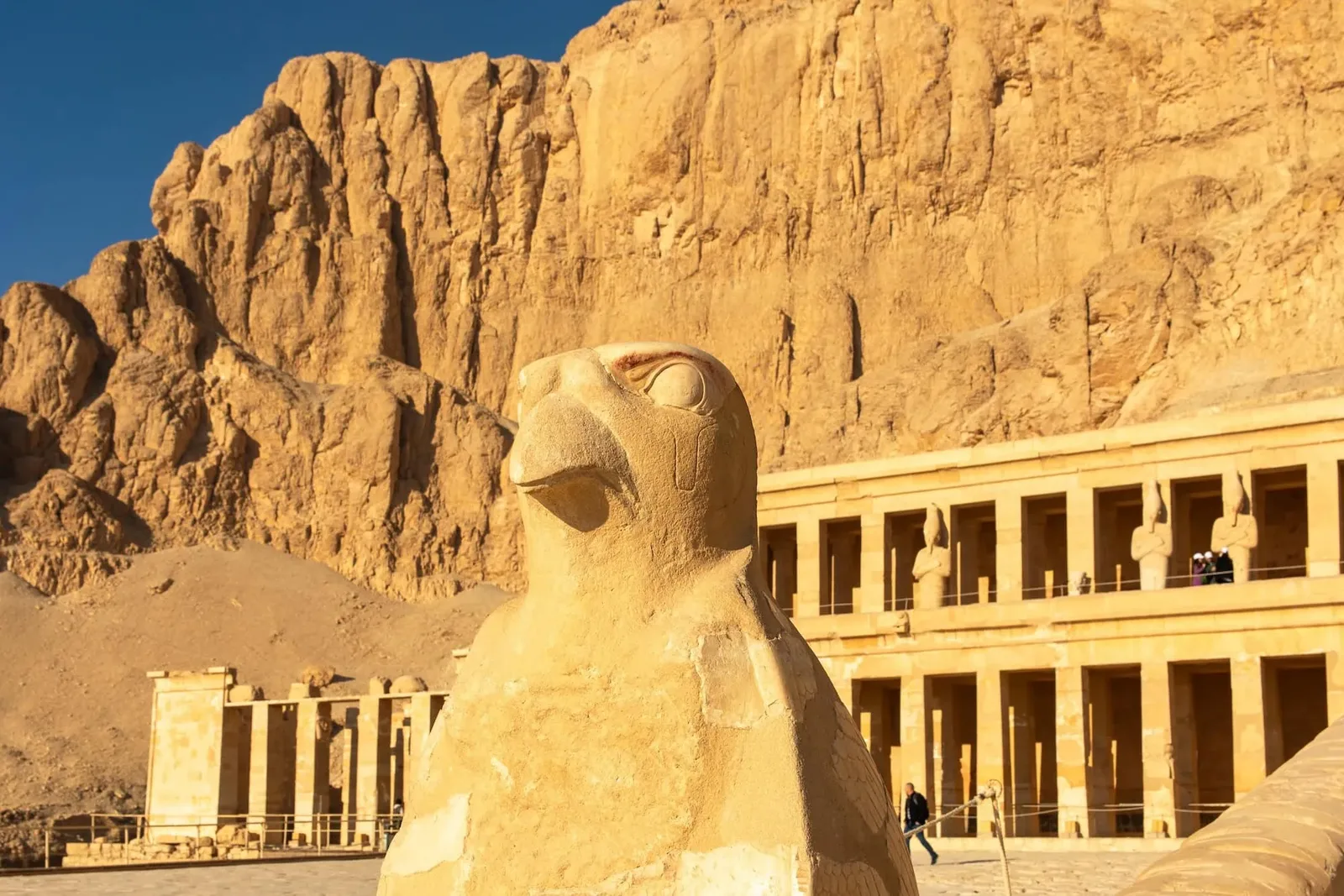
The religion of ancient Egypt was one of the richest the world has seen. It had hundreds of deities, many with the heads of animals, each tied to a force of nature or a part of life: Ra, the sun; Isis, the mother and healer; Hathor, joy and love; Thoth, writing and wisdom; Horus, kingship and the sky. The most important story of all, though, belongs to Osiris.
The myth of Osiris. Osiris was a good king who taught people agriculture and law. His jealous brother Set killed him and scattered his body. His wife Isis searched the land, gathered the pieces and restored him long enough to conceive a son, Horus. Osiris became ruler of the underworld, and Horus grew up to defeat Set and claim the throne. Every living pharaoh was Horus, and every dead pharaoh became Osiris. It is the story of life, death and renewal, told in a world where the river did exactly that every year.
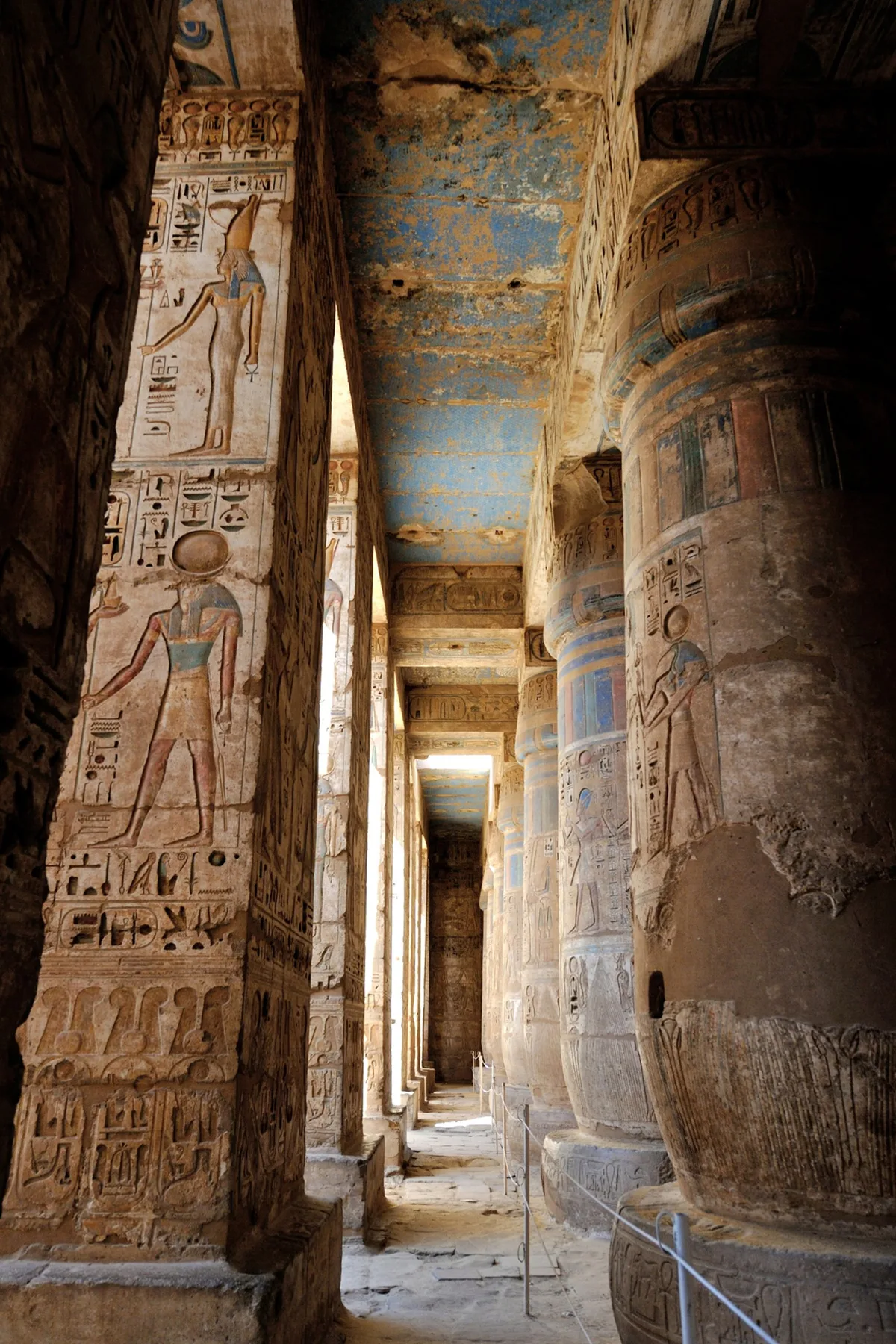
Anubis and the weighing of the heart. Anubis, the jackal-headed god, was the guardian of tombs and the god of embalming. He guided the dead into the underworld, called the Duat. There, in the Hall of Truth, the dead person had to deny wrongdoing before forty-two judges, and then Anubis weighed their heart on a golden scale against the feather of Ma'at, the symbol of truth and cosmic balance. Thoth, the scribe of the gods, recorded the verdict. A heart lighter than the feather, or equal to it, earned a place before Osiris and passage onward to the Field of Reeds, a paradise of endless harvests. A heart heavy with wrongdoing was eaten by Ammit, a monster part crocodile, part lion and part hippopotamus. It is a vision of justice that still feels modern.
This is why the Egyptians built tombs the way they did. Mummification preserved the body, spells from the so-called Book of the Dead guided the soul through the Duat, and the tomb was stocked with everything the dead might need. The great monuments are not so much monuments to death as monuments to the hope of a good eternity.
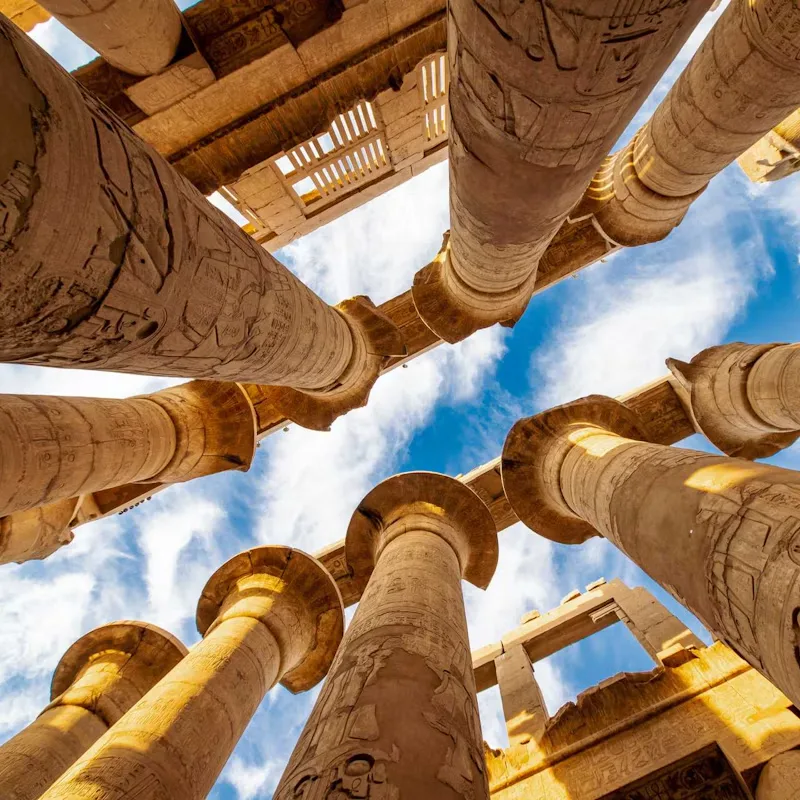
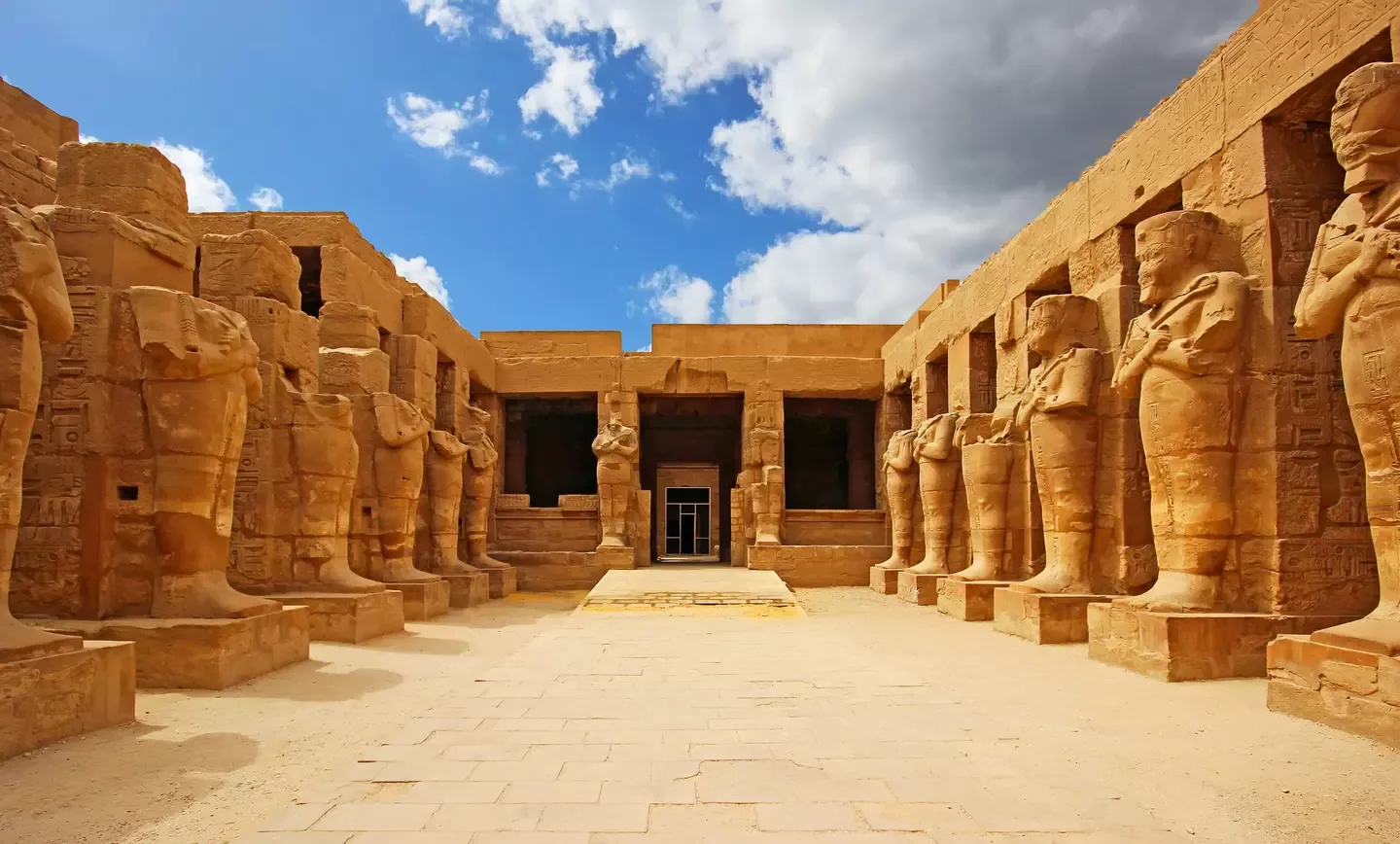
Nowhere is that spirit felt more strongly than at Karnak, near Luxor, a sprawling temple complex built and expanded over around two thousand years. Lonely Planet calls the area "the world's greatest open-air museum," and it is hard to argue when you are standing among its giant columns.
Giza: The Last Wonder Standing
On the edge of Cairo, where the green of the Nile valley gives way to the desert, stand the pyramids of Giza. The Great Pyramid, built for the pharaoh Khufu around 2584 to 2561 BC, is the oldest of the Seven Wonders of the Ancient World and the only one still standing. Two of those seven wonders were in Egypt: the Great Pyramid, and the Lighthouse of Alexandria, which is long gone.
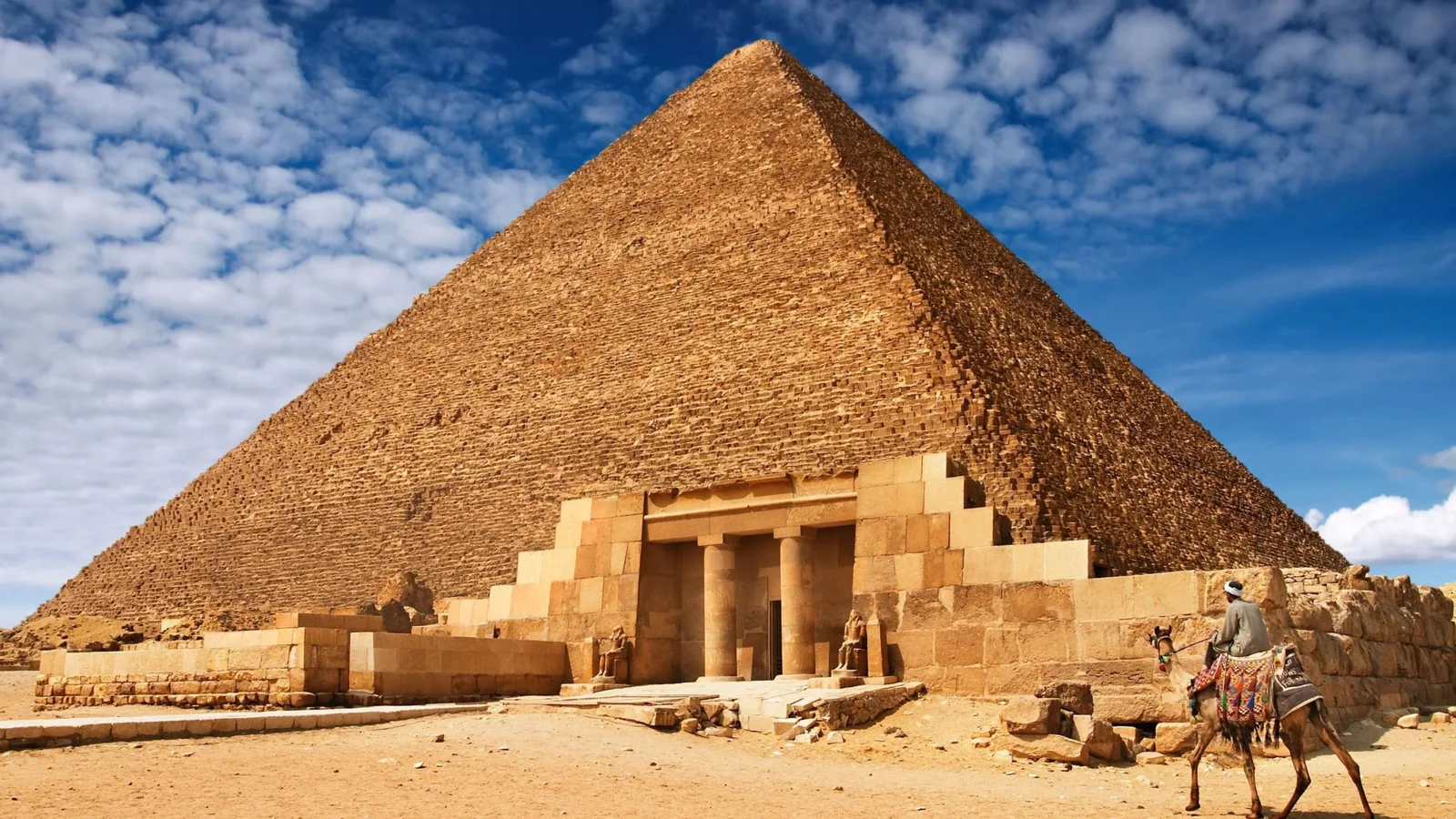
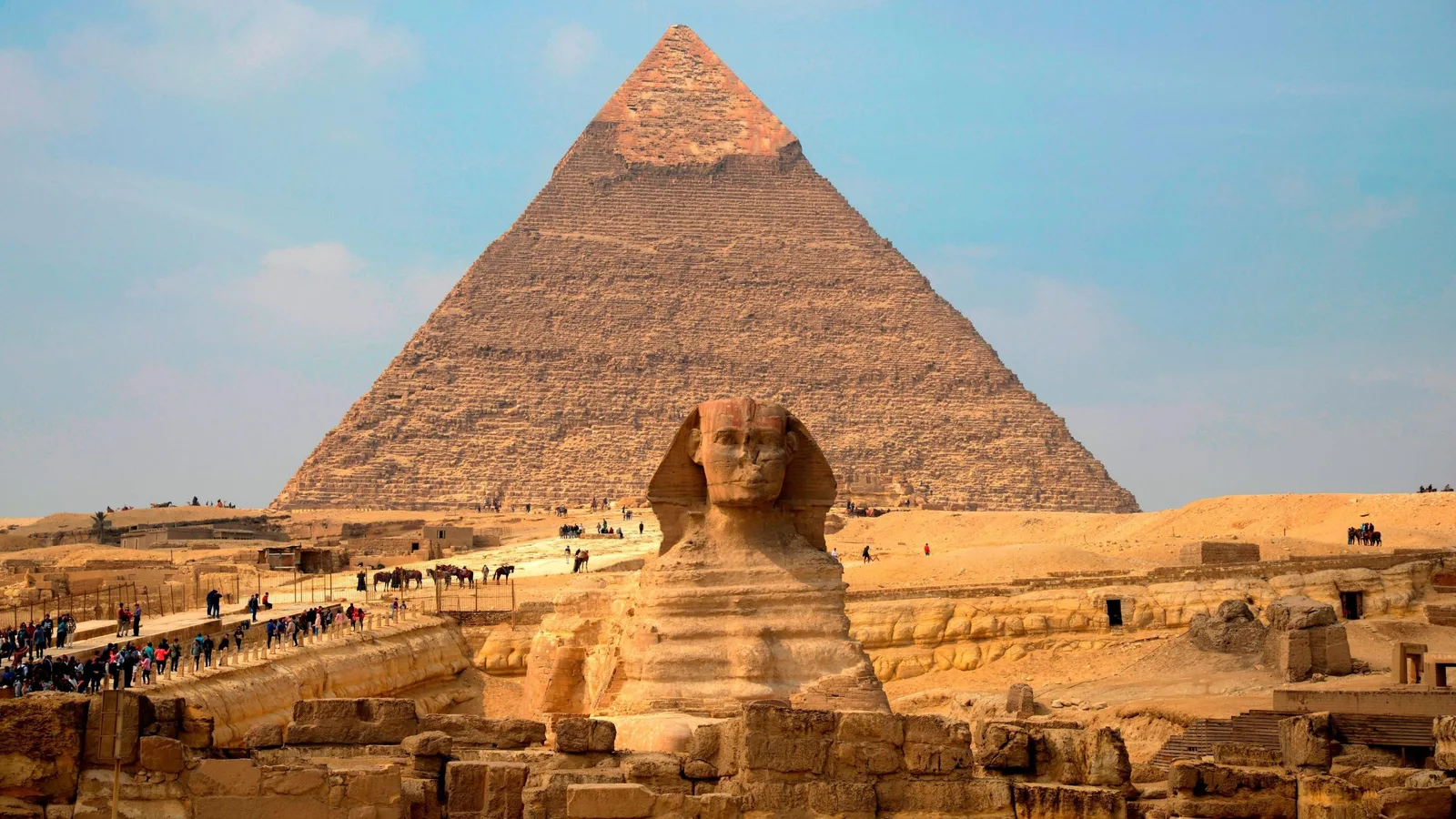
The Egyptians called it Akhet-Khufu, "Horizon of Khufu." Imagine arriving from the desert to see it as it once stood, sheathed in polished white stone, a mountain made of light. Today you can still catch a hint of that in the pyramid of Khafre, whose peak keeps a cap of its original casing.
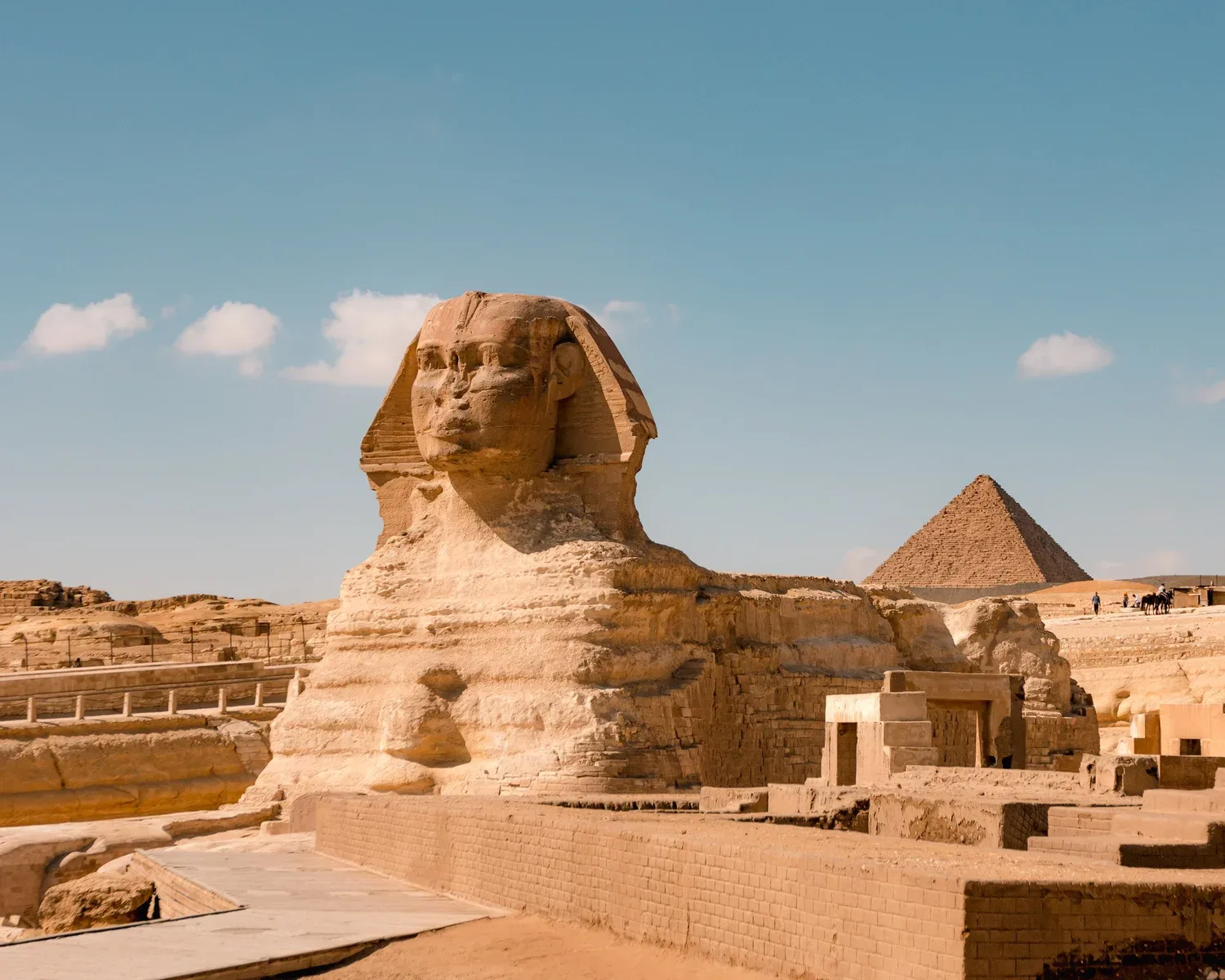
Beside the pyramids, the Great Sphinx crouches in the sand, a lion with a human face, carved out of the bedrock of the plateau. Most Egyptologists link it to Khafre, whose pyramid rises behind it, though its exact builder and purpose are still debated. Whoever made it, the Sphinx has stared eastward for something like 4,500 years, a riddle that has not been solved.
So, How Were They Built?
For a long time, this was the great unanswered question, and in 2013 a stunning piece of evidence emerged. Archaeologists Pierre Tallet and Gregory Marouard were excavating an ancient harbor called Wadi al-Jarf on the Red Sea coast when they found papyri, the oldest inscribed papyri ever discovered. Among them was the logbook of an official named Merer.
Merer was an inspector who led a crew of around 200 men. His diary, dated to roughly the 26th and 27th years of Khufu's reign, records how his team shipped blocks of fine white limestone from the quarries at Tura to Giza, about 15 to 20 kilometers away, sailing upriver on the Nile in about two days and returning in one. Each boat carried around thirty casing blocks, each weighing about 2.5 tons. His boss was Ankh-haf, Khufu's half-brother, who appears to have been in charge of finishing the pyramid. Other papyri are supply records, laid out almost like a modern spreadsheet, tracking bread, beer, grain and meat for a workforce of about 20,000 people.
In other words, the Great Pyramid was built by organized, fed and managed teams of Egyptians, not by slaves under a whip, as the old movies had it, and not by visitors from the stars. The diary calls the pyramid by its real name. It is the closest thing we have to a work journal from the construction site, and it is remarkable.
Aliens, Conspiracies and the Question of Who Built It
And yet the question will not go away, and it is a fair question to ask: how could people with copper tools and ropes build something like this? Since the 1960s, writers such as Erich von Däniken have argued that ancient Egypt appeared as a "ready-made" civilization, and that the big stones, their precise fit and the distances they traveled point to help from extraterrestrials. Television series and countless documentaries have carried the idea to millions of viewers. The theories have grown to include lost chambers, advanced technology and a hidden history.
It is worth looking at what the strange stuff is. Egypt does have real, unsolved mysteries:
- The hidden void. In 2017, scans reportedly detected a large empty space above the Grand Gallery inside Khufu's pyramid, with no known entrance or passage and no known purpose.
- The lost labyrinth. Herodotus described a vast, multi-level labyrinth in Egypt some 2,500 years ago. A 2008 radar survey was reported to have found a large stone foundation beneath the Giza plateau, which has not been excavated.
- The Dendera "light bulb." A relief in the Temple of Hathor at Dendera looks to some like a glowing tube, and has been compared to a 19th-century Crookes tube. Egyptologists read it as a lotus flower and serpent from creation mythology.
- The Sphinx's age. Some claim water erosion on the Sphinx suggests it is far older than the mainstream date. That is a minority view, and the claim has not won over most geologists or Egyptologists.
- The missing queen. Nefertiti's tomb has never been found. She vanishes from the records around year 12 of her husband Akhenaten's reign.
Here is where the evidence and the theories part ways. The pyramids did not appear from nowhere. You can trace Egyptian monument building step by step: simple mastaba tombs, then Djoser's stepped pyramid, then Sneferu's experiments with the shape, then Giza. Mainstream archaeologists have shown that stones up to around 40 tons can be moved with known methods, ramps, sledges and large crews, and the Merer papyri document the work in a worker's own handwriting. The scientific consensus is that none of the "mysteries" needs aliens to explain it.
There is also a human dimension to the alien theory that is worth saying plainly. Many scholars point out that the idea quietly suggests the ancient Egyptians could not have built their own wonders. Critics call that insulting to the builders, and note that von Däniken described his aliens as light-skinned. You can enjoy the mystery without it. Honestly, the real story may be more astonishing. It is a society with no iron tools and no wheeled cranes that organized tens of thousands of people, fed them with bread and beer, moved millions of blocks by river and ramp, and aligned the result to the points of the compass with remarkable accuracy, all within a lifetime.
The conspiracy theories are wonderful stories. They are best enjoyed as stories.
King Tut and the Curse
If the Great Pyramid is the symbol of Egypt's power, Tutankhamun is the symbol of its mystery. He was a boy king who took the throne young and died around 1323 BC at about the age of 19, and he would be a footnote of history had his tomb not survived almost untouched. In 1922, the British archaeologist Howard Carter, working for Lord Carnarvon, discovered it in the Valley of the Kings. The gold, the chariots, the famous golden mask, thousands of objects, were seen all over the world, and a global craze for ancient Egypt began.
Then the headlines turned dark. On April 5, 1923, Lord Carnarvon died in a Cairo hospital, reportedly from pneumonia that followed an infected insect bite that he had cut open while shaving. Newspapers reported that the lights of Cairo went out at the moment he died, and that his dog died back in England that same hour. The "Curse of the Pharaohs" was born: whoever disturbed the king would die.
The truth is murkier. Depending on who is counted, newspapers blamed anywhere from nine to more than twenty deaths on the curse. Some of those people never entered the tomb, and many of the deaths were accidents. Howard Carter himself lived for years afterward. Scientists have offered other explanations. A 2003 letter in The Lancet suggested that a common mold, aspergillus, could have sickened Carnarvon, who had weak lungs from a car accident decades before. A 2013 Harvard study of the tomb's brown spots found fungi and bacteria that were no longer active. And a physician pointed out that with so many visitors to the tomb, a few deaths would be expected by chance. The cause of Tutankhamun's own death is still debated. Theories include malaria, genetic disorders, a skull injury and a broken knee from a chariot accident.
Whether you believe in curses or not, the story endures because it captures something true about Egypt: the sense that the past is not quite finished with us.
Egypt on Screen: Stargate
The idea that something from the sky built Egypt has fascinated screenwriters as much as theorists. The 1994 film Stargate imagined that the sun god Ra was an alien who enslaved humans and moved them to another world about five thousand years ago, and that an ancient ring of stone, the Stargate, could bridge the stars. In 1997 the television series Stargate SG-1 grew the idea into a ten-season universe. Its main villains, the Goa'uld, are parasitic aliens who posed as the gods of Earth's ancient cultures. The Egyptian ones are the best known: Apophis, named for the serpent of chaos; Anubis, with his jackal helmet; Osiris, borrowed from the god of the dead; and soldiers in falcon-shaped helmets modeled on Horus.
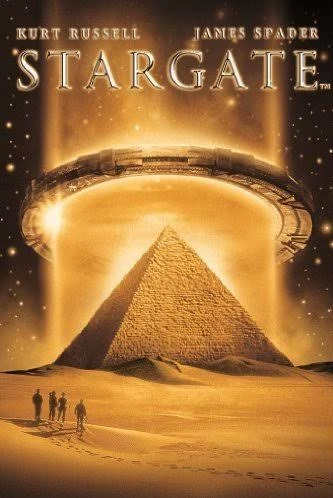
Part of the reason Stargate works so well is that Egypt's real imagery, the pyramids, the animal-headed gods, the tomb carvings that look like pictures of another world, already feels alien. The show took the "ancient aliens" idea and told it as science fiction, with the honest label of fiction. There is a lesson in that, too: the best answer to a conspiracy theory is sometimes a great story told as a story.
The Wonders Worth the Journey
All of this is wonderful to read about. It is better to stand in the sand. A well-planned trip to Egypt follows the Nile, and Lonely Planet's 10-day "Nights on the Nile" itinerary is a good model of how the pieces fit together:
- Cairo and Giza. The pyramids, the Sphinx and the Grand Egyptian Museum. You can even ride a camel around the pyramids.
- Luxor. Karnak and Luxor Temples. Hatshepsut’s temple and the Valley of the Kings lie across the river and are a natural addition.
- A Nile cruise. Four nights sailing from Luxor to Aswan, passing the temples of Esna, Edfu and Kom Ombo from the deck, where the real Egypt of villages, farms and palm groves slides by.
- Aswan. Philae Temple, and a motorboat to the Nubian village of Gharb Soheil, where color and hospitality meet the desert.
- Alexandria. The catacombs and the modern Library of Alexandria, on the Mediterranean, where Greek and Roman Egypt lived.
- Dahshur. The early pyramids where the true pyramid shape was worked out, and a cooking experience with local farmers.
Practical notes, offered with respect for your time: go in the cooler months if you can, since the summer heat in the south is intense. Go early in the day at the major sites, before the crowds and the sun. Bring a hat, water and good walking shoes. Use licensed guides, and book through reputable companies. Check current official travel advisories before you book.
And give yourself a quiet moment. At some point, at sunset on the river, or when the sun lights the face of the Sphinx, put the camera down. Egypt has been waiting for travelers for five thousand years. It can wait a few minutes while you simply look.
The river is older than the kings, and the kings are older than our questions.
Sources: Wikipedia, Seven Wonders of the Ancient World; Lonely Planet, 10 Days in Egypt: Nights on the Nile; Egypt Tours Portal, Top Unsolved Mysteries of Ancient Egypt; Amusing Planet, The Diary of Merer; ScienceAlert, The mundane explanation for King Tut's curse; The Collector, The Weighing of the Heart Ceremony; Wikipedia, Mythology of Stargate; Wikipedia, Ancient astronauts; TheTorah.com, The Pharaoh of the Exodus.