Mystery · Article
Crop Circles: Art, Hoax or Something Else?
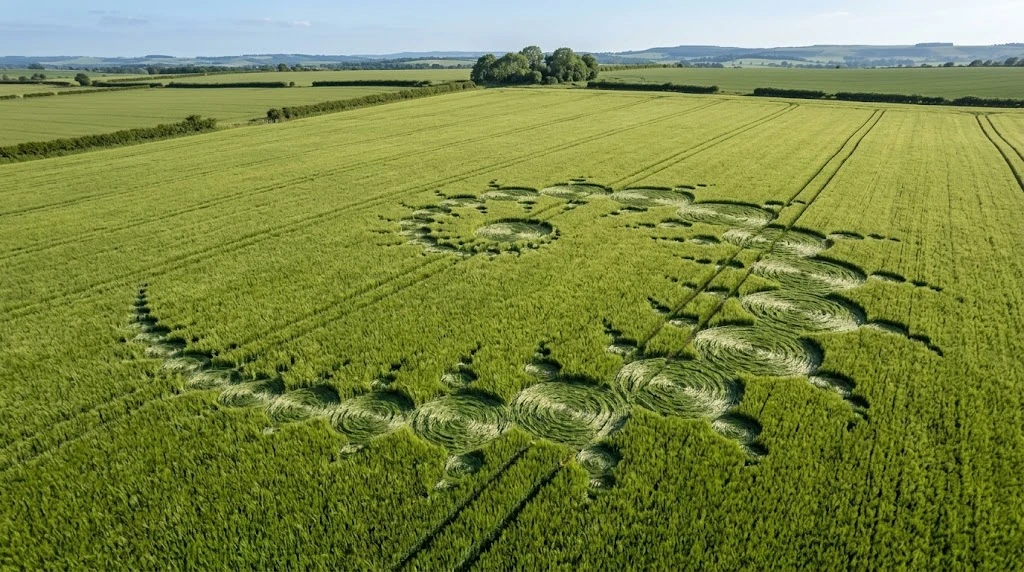
Every summer, a field in southern England wakes up with a perfect pattern pressed into the crop. Nobody saw it happen, and that is where the story starts.
Where the story starts
Flattened rings in grain are older than the word for them. A 1678 English pamphlet, The Mowing-Devil, describes a field cut in a strange pattern. In 1880 a reader wrote to the journal Nature about circles in Surrey wheat and blamed wind. Reports followed from Wiltshire in 1963, then from Australia and Canada in the mid-1960s. The term “crop circle” itself only arrived in the early 1980s.
The two men with a plank
In 1991, two Englishmen, Doug Bower and Dave Chorley, said they had been making the circles since 1978. They claimed more than 200 of them, using a plank of wood, a length of rope and a cap fitted with a wire loop to help them walk a straight line. They showed journalists how it was done. One researcher, who had already called the demonstration circle authentic, had to take it back.
The other explanations
Before the confession, scientists such as Terence Meaden proposed whirlwinds and a “plasma vortex” as the cause, and that idea faded after 1991. Others argued that real circles show odd changes in the plants. Skeptics reply that every feature reported so far fits human hands, and that stalks can bend without breaking when the crop is wet. In 2002 the Discovery Channel asked MIT students to build circles and test the claimed “real” features. Anyone willing to believe in aliens or plasma still has to explain why the pattern keeps showing up so close to roads and monuments.
The alien question
The idea of visitors from space took hold in the 1980s, when researcher Colin Andrews and Pat Delgado documented circles and co-wrote the book Circular Evidence. The pattern had a head start in fiction: the 1974 film Phase IV shows a geometric crop circle, and some think it influenced the pranksters. The honest answer is that no circle has ever been traced to a craft or a visitor. Every one that has been looked into came back to people, tools and a dark night. What stays unexplained is how the best designs are laid out so cleanly, overnight, in the dark, and the answer there is practice and teamwork.
Myths and conspiracy theories
Around the circles grew a set of claims that spread faster than the facts. Here are the common ones, and what holds up.
- “Two men could not have made them all.” Believers say Bower and Chorley’s confession was a cover story. The two never claimed every circle, only more than 200, and groups of artists have since copied and extended the craft.
- “The stalks are bent, not broken, so it cannot be human.” Skeptics point out that crops can be bent without breaking after rain, and the 2002 MIT test was set up to check this.
- “The plants show strange changes.” A 1994 study by William Levengood reported grain deformities. Joe Nickell criticized the method in 1996 as circular reasoning.
- “It is a government cover-up.” There is no public evidence for this. Plain explanations fit the facts without one.
Why southern England?
A 2002 study by Jeremy Northcote found that British circles cluster near roads, towns and ancient sites such as Stonehenge and Avebury. In 2003, nearly half of the UK’s circles were found within 15 km of Avebury. That points toward the easiest places to make a circle and have it found, not toward a cosmic address.
Why we still look
The patterns have grown from simple rings into huge geometric designs that you only see properly from the air. They have shown up in films, on album covers and in Olympic imagery, and they draw visitors to Wiltshire every summer. In 2000, Matthew Williams became the first person in the UK prosecuted for making one and was fined £100. The mystery is smaller than the legend, and the art is better than the hoax.
Source: Wikipedia, “Crop circle”.